Showing posts with label Exeter cathedral. Show all posts

Tuesday, 14 September 2010

Exeter Cathedral - Bishop Bronscombe


The tomb of Bishop Bronscombe, between the Lady Chapel and the Chapel of St Gabriel is the finest in the cathedral.


Bishop Walter Bronscombe - known as Walter the Good - became Bishop of Exeter in 1257 and probably attended the consecration of Salisbury Cathedral in 1258. This is thought to have inspired him to rebuild Exeter on a larger scale in Gothic style. The present building is largely the result of his plans. He died in 1280.


In the background can be seen the effigy of Bishop Stafford on the other side of the Lady Chapel in a similar gilded monument.


His effigy in black basalt has survived with its original painted colouring.    The bishop is shown wearing the magnificent robes of a prelate of his time.


An angel carries his shield.


The brilliantly gilded monument is later than the effigy itself, having been made in the Fifteenth Century.

Saturday, 11 September 2010

Exeter Cathedral - Martyrs' Pulpit


The pulpit was designed by Sir George Gilbert Scott who carried out restoration work at the cathedral in the 1870s. 


It depicts the martyrdom od Saints Alban and Boniface and of Bishop John Coleridge Patteson, a Devonian who became the first Bishop of Melanesia in the South Pacific and was martyred in 1871.  The pulpit was erected in 1877. 

Wednesday, 8 September 2010

Exeter Cathedral - Rondels


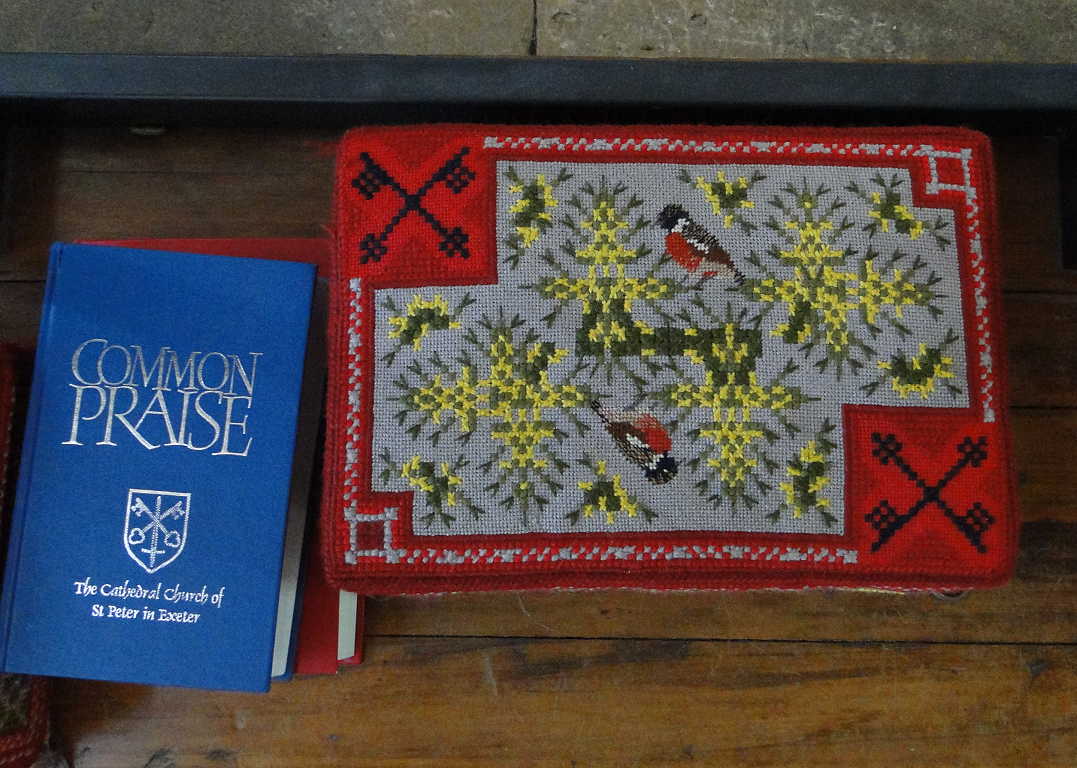
All around the nave of the cathedral are embroidered cushions, called the Exeter Rondels, covering the stone seats.


They describe the story of the cathedral from its beginnings to modern times and athe work of volunteers.


 The names of the Bishops, deans and monarchs accompany the scenes throughout the ages.


This rondel describes the creation of the elephant misericord, a mid-thirteenth century carving.


Misericords are seats which when tipped up provide a ledge on which one could prop oneself during long services. Those in Exeter are among the earliest in England.

Tuesday, 7 September 2010

Exeter Cathedral - bosses


In architecture, a boss is a knob or protrusion of stone or wood. Bosses can often be found in the ceilings of buildings, particularly at the intersection of a vault.


Some of the bosses at Exeter Cathedral weigh as much as two tons. This model of a boss is at ground level and is designed to show visitors how big the bosses are.


This boss depicts the murder of Thams Becket in 1170. Born in 1118 he was Archbishop of Canterbury from 1162. He was later also known as Thomas à Becket and his death made him an instant martyr.


These bosses depict the Green Man. A Green Man is a sculpture, drawing, or other representation of a face surrounded by or made from leaves. Branches or vines may sprout from the nose, mouth, nostrils or other parts of the face and these shoots may bear flowers or fruit. The Green Man motif has many variations and is found in many cultures around the world' It is often related to natural vegetative deities and is primarily interpreted as a symbol of rebirth or renaissance, representing the cycle of growth each spring.


Some of the bosses represnt other creatures - both real and mythical.

Monday, 6 September 2010

Exeter Cathedral - Minstrels' Gallery


This unique Minstrels' Gallery is carved with fourteen angels playing musical instruments.  In fact this is a screen in front of a room which acts as an echo chamber and it is pierced so that the sound can float down into the nave below.  At Christmas and various other occasions choristers still use this to create a remarkable disembodied sound.

Sunday, 5 September 2010

Exeter Cathedral - cat hole


This cat hole in a door in the South Transept of Exeter Cathedral is centuries old.


It gave the cat access to the South tower in order for it to keep down the rats and mice in there. In the Fifteenth Century the Cathedral accounts allowed a penny a week for the cat's food.

Saturday, 4 September 2010

Exeter Cathedral - Chapel of St Saviour and St Boniface


Hugh Oldham, Bishop of Exeter, 1504-1519.  He founded Manchester Grammar School and was a co-founder of Corpus Christi College, Oxford.

Exeter Cathedral - kneelers