Showing posts with label Exeter University. Show all posts

Thursday, 11 September 2008

The University grounds again

Wednesday was a long day. Actually it probably wasn't any longer than any other day but what I mean is I had a long time out and about. I began at the University, photographing trees and fungi again, and then went to the city centre where I concentrated on taking photos inside the cathedral and of a statue being replaced on the North porch.


A Magpie greeted me as I wandered the University grounds in the sunshine.


Reedmace by the Peter Chalk fountain.


A Monterey Pine - it's a long way up there!


Reed Hall and its terracing are the most attractive part of the campus.


The cones of West Himalayan Spruce and Noble Fir respectively.


A rather spectacular Lawson's Cypress.


These lovely little fellows are Coprinus plicatilis - the Little Japanese Umbrella.


This fungus appeared at first to be a jelly cup of some sort - possibly Peziza violacea - but a closer examination suggest the remains of gills so perhaps it is just a toadstool like Cortinarius violaceus that has been eaten by squirrels or slugs.


The Common Brownie - Tubaria furcfuracea.


I think this is Lepista irina, noted for growing in lines or circles.


This was supposed to be a Scarlet Oak according to the label but in no way does it resemble one!

Friday, 5 September 2008

Exeter University grounds again


Inspired by John Caldwell et al "The Grounds and Gardens of the University of Exeter" I had another wander around the University on Thursday morning. The weather was far from ideal for photographing trees but that only marginally reduced the enjoyment.


Ian parked the car by a Silver Maple and he and Helen left me to it. They went off to work - poor souls - while I soaked up the peace and calm of the arboretum and the terraces of Reed Hall.


This large and strikingly powerful sculpture commemorates the tragic events in Tiananmen Square, Beijing on 3rd and 4th June 1989. It was anonymously erected overnight in 1989 by some of the University's students and every June wreathes are laid against it.


This sculpture - "Man of the World" - is by Peter Peri. It was created in 1960 to symbolise the new University's aspirations, reaching out to the World. The feet of this sculpture are encircled by Rams horns. This is an allusion to the roots of the University, the Royal Albert Memorial College in Exeter, now a museum and art gallery.


This chap is on Reed Hall. I shan't bore you with all the tree photos I took - because of the weather they were primarily 'for the record' and to add to my collection of tree photos rather than making pretty pictures.


But I must show you this shrub - Colletia cruciata - with its vicious thorns. It would make a good anti-personnel hedge.


It's a pity I no longer collect cones; I could have added greatly to my one-time collection. This is a Moneterey Pine cone and was surprisingly light.

Saturday, 30 August 2008

Exeter University - the Tree hunt

I won't bore you with photos of all the trees I took as I went around the University but these are a few of the more interesting images.


Common Elm (Ulmus procera) is now a rare tree in many parts of the country so it was pleasing to find one that had survived in the staff car park.  (See Comment below!)


Fastigate Hornbeam (Carpinus betulus pyramidalis).


The light was really poor for taking photos of trees but at least the absence of the sun meant that the angle didn't matter since one was never against the sun. This is a Monterey Pine (Pinus radiata).


In The Plantation there were some beautiful Hart's Tongue Ferns.


Most of the trees in The Plantation are not named - either on the ground or in the book. I was attracted to this small tree by the half-eaten fruits on the ground - presumably the work of the Grey Squirrels who could be seen scampering around.


The bark of an exotic Birch species.
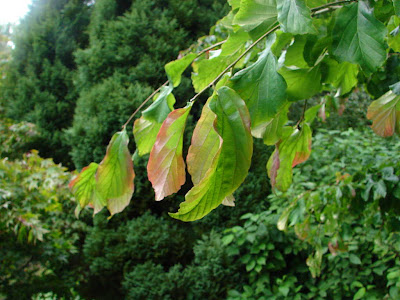

Helen has a wonderful photo of the leaves of this tree by the pond on North Park Road. Unfortunately I am still unable to identify it.


A lot of the plants were covered in dewy cobwebs.


This sculpture on the side of the Peter Chalk Centre is called the Minoprio Fountain after its architect Anthony Minoprio who donated it to the University as part of his work to encourage water sculptures in public settings.


This a Nikko Fir (Abies homolepis).


A number of cones were beneath both it and an adjacent pine but were totally unrecognisable after the Squirrels had been at them.


An immature Gull was amongst the birdlife of the university gardens.


A scruffy moulting Magpie was also there.


Barbara Hepwrth's sculpture "Figure for Landscape".


Wild Radish in a newly sown lawn.


This subspecies of the Spanish Oak is known as the Exeter Oak (Quercus x hispanica lucombiana).

Exeter University - a Fungi Foray


Ian took me into the University on Friday morning and I had planned to take advantage of Helen's book about the grounds and gardens to identify some of the trees. In the end it turned out to be as much a fungi foray as a tree hunt.


Agaricus sylvatica - the Scaly Wood Mushroom.


This is a Russula species.


This is another Russula - probably R. xerampelina.


This is the Panther Cap (Amanita pantherina).


And another Amanita - possibly the same species.


This is the Giant Polypore (Meripuls giganteus). {Yes, Mark, we've found the missing leg!!!}


An unidentified fungus.


A Boletus species - probably B. erythropus.