Sunday, 17 May 2009

Eighteen months or so

Helen and Ian moved into Frog End in September 2007.

This is the difference they have made to the back garden in that time.


September 2007


August 2008


May 2009

Two ponds, a lawn, fencing, flowerbeds, trees, vegetable garden - it's all a bit different, isn't it. Not bad for about 20 months when you bear in mind they've worked on the house as well.

Saturday, 16 May 2009

Rambling at Frog-End


Rambling at Frog-End.


Daughter-who-takes-photos is described by GB as Niece-who-loves-nature. One aspect of nature that she doesn't like is anything arachnological! So when she found a nest of 200 baby Garden Spiders she was kind enough to call me to photograph them but kept well clear herself.


One of the spells of sunshine on Saturday brought out some hoverflies. This is Episyrphus balteatus, a common species.


The clematis has had lots of flowers on for a while now - it is Clematis 'Pink Champagne'.


This Ichneumon fly was wandering over the Hydrangea searching for eggs or caterpillars in which to lay its own eggs. The sharp thing at its rear end is not a sting but an ovipositor for piercing things so as to lay its eggs inside them.


These Primula japonica are among the flowers helping to make the back garden look attractive at this time of year.


And the Sweet Rocket and Geums have just come out in the last week.

Friday, 15 May 2009

The House That Moved


GB has blogged about people moving house in New Zealand on a couple of occasions. This is another house that moved. The House That Moved, looks like it has always been in its present position and is a favourite on the tourist itinerary.


Once known as Merchant House, it was in the way of a new road being built in Exeter in 1961 and was scheduled for demolition. It dated from about 1500, although some thought it may be as old as 14th century. It was certainly one of the oldest surviving houses in Exeter. In a poor state of repair, it didn't seem that important a loss to some people but with pressure from archaeologists, it was 'listed' just in time, as an important building of architectural and historic significance, and the demolition was halted. Exeter City Council, with help from the government decided to spend £10,000 to have the house moved out of the way of the new road.


A London company was contracted to move the house about 100 yards from its site on the corner of Edmund Street and Frog Street to a new position by the old West Gate. It took several weeks to prepare the house for the move - the timber framework of the house was criss-crossed with strengthening timbers and iron wheels placed at each corner attached to hydraulic jacks. No iron bolts, screws or supports were used against the original timbers, to prevent damage. The structure was top heavy, so during the move, the jacks would be used to ensure that it was always kept upright, with frequent checks made using spirit levels. During the move a mouse was seen wandering about in the timbers!


After its move it was occupied by an antique dealer, then a gem dealer and now it is a wedding dress shop. It has a rear kitchen, a first floor hall, or principal living room and on the top floor was the solar, or principal bedroom.

A visitor to Frog End

Frog End has had a visitor for a couple of nights running. He has upset a few plant pots and knocked a few logs around.


Hopefully Helen and Ian will not mind that and think his visits are in a good cause - there are certainly fewer slugs around this morning.

Bishop Blaize


Bishop Blaize is believed to have been a bishop of Sebastea in Armenia who was martyred under the reign of Licinius in 298 AD. He received a message from God to go into the hills to escape persecution. Men hunting in the mountains discovered a cave surrounded by wild animals who were sick. Blaize walked among the animals, curing them of their illnesses. Recognizing Blaise as a bishop, they captured him to take him back for trial. On the way back, he talked a wolf into releasing a pig that belonged to a poor woman. When Blaize was sentenced to be starved to death, the woman, in gratitude, sneaked into the prison with food and candles. Finally Blaize was killed by the governor. He became the patron saint of clothworkers because it is alleged he was scourged with iron combs before being beheaded. He is also said to have saved a boy from choking and consequently is the relevant saint for throat ailments. The inn sign shows the Bishop holding a woolcomb, the symbol of his martyrdom.


This was the first public house to be built just outside the city walls and there has been a pub here in Commercial Road since 1327. The building looks like two terraced cottages with the higher leat running behind to Cricklepit Mill and, at one time, other fulling and gristing mills. Standing next to the drying racks for the woollen trade, the building was used in medieval times as a meeting place for the local mill owners. The lower leat used to run across the front of the building, and customers had to cross a small bridge to reach the entrance. The leat was covered over around the mid 1960s.

On Wednesday morning I was shown around the mill by a very helpful and knowledgeable young lady from Devon Wildlife Trust who mentioned, inter alia, the Bishop Blaize and it's connection with fulling. On the Internet I came across some information about the Bishop which also forms a nice link with the Trust. Blaize is the patron saint of wild animals because of his care for them.

Catholic.org suggests that to follow in his footsteps one could take time as Saint Blaize did to find out how you can help wild animals. Find out what is being done to support and protect the wildlife in your area. There is wildlife everywhere, even in cities. Even a birdfeeder can help God's creatures survive. Aternatively, you could join your local Wildlife Trust.

Thursday, 14 May 2009

Along the River Exe


Along the quayside and the river the cracks in the walls have plants sprouting from them and are a mass of colour. This is Ivy-leaved Toadflax.


I think this is a clover of some sort but I have yet to identify it.


These daisy-like flowers are Mexican Fleabane. It is abiundant around the quay area.
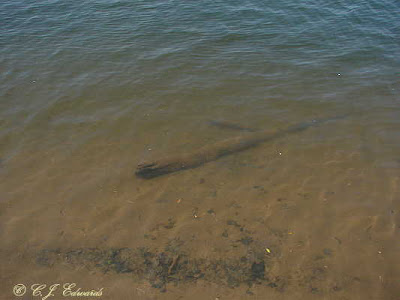

The water in the Exe is remarkably clear for such a big river.


This splendid Ceanothus was outside some flats on the waterside.


I wonder if there is a message in it?


This is Trews Weir on the River Exe.


Trews Weir Suspension Bridge was constructed in 1935 and in the 1990s it was re-furbished and re-opened to the public.


Looking back at the weir and quay.


Looking downriver from the bridge.


I crossed over the bridge and had a walk along the other bank - the canal side - for a while but decided the scenery had looked better on the Eastern side.


This is Water Speedwell (Veronica anagallis-aquatica).


I was really glad I had this spell on the Western side because otherwise I would have missed this potter or mason wasp (possibly Ancistrocerus antilope).


That's assuming you live to get fined!


I carried on walking down the riverside until I came to Belle Isle Park where this beautiful Weeping Willow was hanging over the water's edge.


Further along more willows, lime and hawthorn all overhung the water.


This is Comfrey. Once I made battered comfrey leaves, following a country recipe book I had. They tasted like furry dishcloths. not an experiment to be repeated.


This netting was placed around a swans nest but whether to protect the swans from people or vice versa was not clear. Sadly, a swan on a nest just down the river was attacked and killed by a bull terrier last week. That made the headlines in the Exeter newspaper - a bit different to the gang shootings that all too often are the headlines back home.


The swan had four eggs. According to a resident, out for a stroll, last year this nest had seven eggs but despite all seven hatching only one survived the first week. It is thought the others were killed by a Mink.


The cob was in close attendance on the river.

All in all a beautiful walk in ideal weather.
Exeter Quay

Exeter has had a quay since Roman times. Despite rival traders at Topsham attempting to block the river in the 16th century to stop traffic reaching the city the quay successfully traded with the rest of world for hundreds of years.


Wool and cloth from the area was exported and this customs house was built in 1680. Imports included olive oil, wine and salt cod.


The Customs House can be seen on the right of this picture. It is one of the earliest brick buildings in Exeter and said to be the oldest customs house in the country. In the middle of the picture is the fish transit shed and on the right can be seen part of a sculpture made from machinery parts.


It was the arrival of the railways in the mid 19th century that saw the beginning of the end for the quay as a commercial venture. Nowadays the quayside is a tourist area of antique and craft shops and eateries, scattered with bits of machinery acting purely for decoration.


Outside the Customs House are a pair of cannons that were cast in 1796. You have to be next to them to appreciate the size of those things and to imagine the death they might have dealt in the Napoleonic Wars. In fact they were sent back from the Peninsular War as surplus to requirements and have never been fired.


By the Customs House is this delightful old bridge under which the Higher Leat flows into the Exe. Swans galore swim around here. I only realised afterwards that the home of the Devon Wildlife Trust is in a nearby building - Cricklepit Mill - this will be the subject of a separate posting.


This is the Wharfinger's House . It was built in 1778 as a residence for the wharfinger whose job it was to collect the wharfage fees.


This is Quay House which dates back to 1680 and was used to store wool and cloth before it was loaded onto boats.


The Prospect Inn on the quayside is in a part of Quay House and consequently dates back to the 17th Century.


This sign however may be rather economical with the truth since there has only been an inn using the building since the Fountain Inn was established there in 1830. One day I'll get all my photos in order and have a folder full of inn sign pictures. One day!


This is Cricklepit Suspension Bridge. It was built across the Exe in 1988.


I walked past the various craft businesses set along the quayside including this one whence came one of GB's chopping boards last year.


When I win the lottery I shall buy myself a coffee table, a mirror, a chopping board, a cheese board and anything else I can get from this place - they are all first class.

Some more photos of the quay can be found on one of my postings from last year.

Lots of information about the quayside and this area in general can be found on this website.